 New York Architecture Boat Tour
Staten Island Ferry: The Free Crossing Past the Statue of Liberty
The Staten Island Ferry is the cheapest harbor ride in New York City because it costs nothing at all. It runs 24 hours a day, every day of the year, across 5.2 miles of Upper New York Bay between Whitehall Terminal in Manhattan and St. George on Staten Island. The crossing takes about 25 minutes each way, and the route passes close enough to the Statue of Liberty for clear photos from the open deck. This guide covers the fare, the schedule, the terminals, the boats and exactly what you see on the water. If you want a longer cruise with narration and a Liberty photo stop, the paid options are compared too, starting with the 90-minute Statue of Liberty cruise at $34 per person. The bookable tours are compared on New York architecture boat tours.
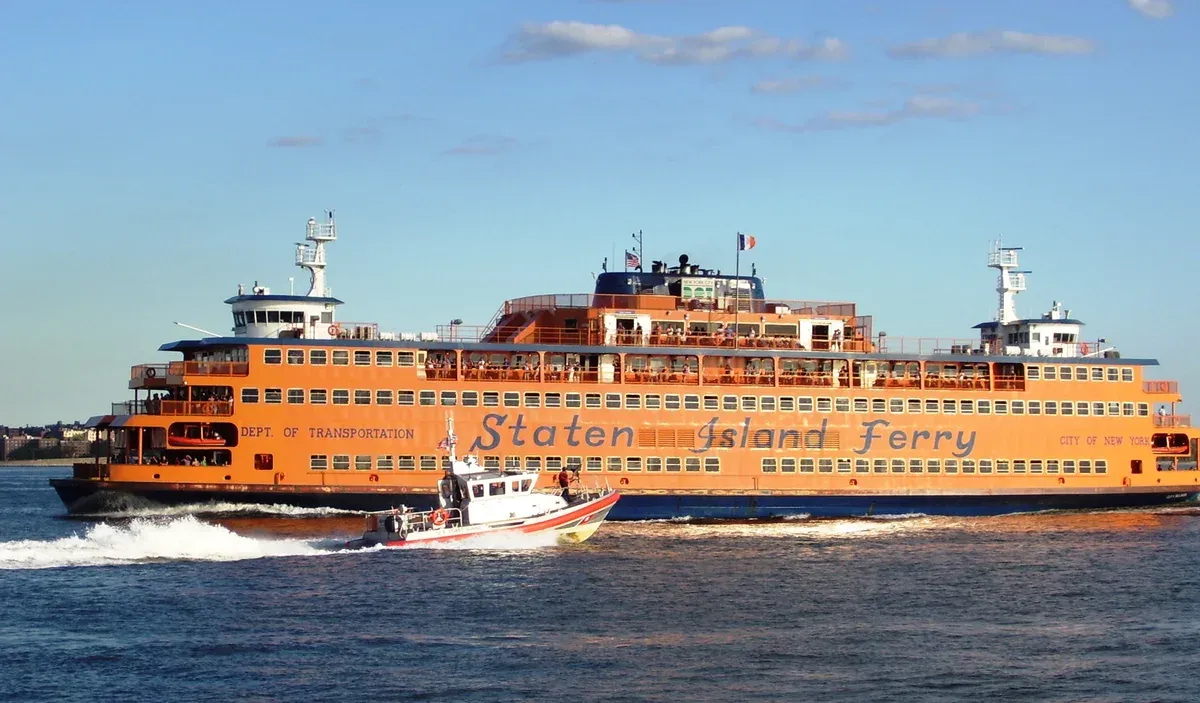
An orange Staten Island Ferry boat crossing New York Harbor with a Coast Guard patrol boat alongside. Photo: Beyond My Ken, CC BY-SA 4.0, via Wikimedia Commons
Quick answer The free 25-minute harbor crossing
The Staten Island Ferry is free, runs 24 hours a day, 7 days a week, and crosses 5.2 miles of Upper New York Bay in about 25 minutes. Boats leave Whitehall Terminal in Manhattan and St. George on Staten Island roughly every 15 to 20 minutes at peak times and every 30 minutes off-peak. You see the Statue of Liberty and the Lower Manhattan skyline from the deck, with no ticket and no reservation.
Key takeaways
- The full basics, from the fare history to the fleet, are in the fare, hours and frequency section.
- For a guided alternative, the 90-Minute NYC Statue of Liberty and Skyline Cruise costs $34 per person with a live or audio guide.
- The full 2.5-hour lap of Manhattan is covered in the Circle Line Full Manhattan Boat Tour, which passes the Statue of Liberty and seven bridges.
- What the water looks like on the way, side by side, is in the crossing section, and more free and paid options sit on the New York architecture boat tours homepage.
Fare, Hours and Frequency
The Staten Island Ferry is run by NYC DOT and carries commuters and sightseers on the same boats, every day of the year. Here are the core facts before you go.
The Essentials at a Glance
Everything in this table comes from NYC DOT and the documented history of the route. The single most asked question, is the Staten Island Ferry free, has a simple answer: yes, and it has been fare-free since 1997. Before that, riders paid 50 cents round trip, a fare introduced in 1990, which itself replaced the 25-cent round trip fare of 1975.
Going further back, the fare was five cents until 1948. The service carried 16,692,900 riders in fiscal year 2025, so expect company on board, especially at weekends. If you want more than the crossing itself, the New York architecture boat tour comparison covers the narrated cruises that charge for what this ferry gives away.
| What | Detail |
|---|---|
| Fare | Free, fare-free since 1997 |
| Operating hours | 24 hours a day, 7 days a week, year-round |
| Route length | 5.2 miles across Upper New York Bay |
| Crossing time | About 25 minutes each way |
| Manhattan terminal | Whitehall Terminal, 4 South Street, three ferry slips |
| Staten Island terminal | St. George Terminal |
| Peak frequency | Every 15 to 20 minutes |
| Off-peak frequency | Every 30 minutes |
| Cars | Not carried, the ferry is passengers only |
| Ridership | 16,692,900 riders in fiscal year 2025 |
| Operator | NYC DOT |
How Often the Boats Leave, and From Where
Boats depart every 15 to 20 minutes at peak times and every 30 minutes off-peak, around the clock. One published source, NYC Tourism, describes weekday service as at least every 30 minutes and hourly on weekends, so treat the tighter figure as the peak standard and check the board at the terminal on the day. Boats come often enough that turning up and walking on works at most hours.
The Manhattan end is the Whitehall Terminal at 4 South Street, beside Battery Park at the southern tip of the island. The nearest subway stations are South Ferry on the 1, N, R and W trains, and Bowling Green on the 4 and 5, both a short walk away. The current terminal building is four stories tall, cost $200 million to rebuild and reopened in 2005 after a fire destroyed the original 1903 building in 1991. It has three ferry slips, 20,000 square feet of retail space and an observation deck facing New York Harbor, which is worth a look even before you board.
On the Staten Island side, boats arrive at St. George Terminal, which first opened in early 1886. The rebuilt terminal you use today opened on June 8, 1951 at a cost of $21 million, after a 1946 fire destroyed the wooden structure. The National Lighthouse Museum, the St. George Theatre and the Staten Island September 11 Memorial are all near the terminal if you decide to step ashore rather than ride straight back.
A note on the return trip: the round trip takes about 50 minutes of sailing, and you can simply stay on board at St. George and ride back. Most sightseers do exactly that. If you are comparing this with NYC Ferry, which charges a fare, or the seasonal Governors Island ferry, the Staten Island Ferry is the one that is free for every rider and runs around the clock.
A Short History of the Route
The Richmond Turnpike Company started the first motorized ferry between New York and Staten Island in 1817. A teenage Cornelius Vanderbilt ran his own ferry service on the route from 1810, using a periauger called Swiftsure, and later sold his operation for $600,000, after which three ferry companies merged in 1853. New York City took the service over on October 25, 1905, paying $3.2 million, including $2 million for five new screw-propelled ships.
By 1967 it was the only commuter ferry left in New York City. Ridership peaked at 27.5 million passengers in 1964, then fell to 22 million the next year when the Verrazzano-Narrows Bridge opened. Even the terminals carry history: the Whitehall Terminal first opened in 1903, and its current building was designed by architect Frederic Schwartz.
Sources: Staten Island Ferry, NYC DOT
The 25-Minute Crossing, Side by Side
The route from Whitehall to St. George is not a loop of Manhattan, it is a straight run across Upper New York Bay. Here is what you see on the way.
Leaving Whitehall: the Lower Manhattan Skyline
The Lower Manhattan skyline frames the Whitehall end of the crossing. One World Trade Center dominates it, at 1,776 feet to the tip of its spire and 1,368 feet to the roof, designed by David Childs of Skidmore, Owings & Merrill. Also in the skyline is the neo-Gothic Woolworth Building, 792 feet tall, designed by Cass Gilbert, which was the world's tallest building from its opening on April 24, 1913 until 1929.
Look for 56 Leonard Street too, the 821-foot Jenga Tower by Herzog & de Meuron, completed in 2017, whose stacked blocks read clearly from the water.
The Statue of Liberty and Governors Island
As the ferry crosses the harbor, the Statue of Liberty comes into view. She stands 151 feet 1 inch to the torch, or 305 feet 1 inch from the ground of Liberty Island to the torch, and she has stood there since her dedication on October 28, 1886. Bartholdi designed her, Eiffel built the iron framework and Richard Morris Hunt designed the pedestal. She became a UNESCO World Heritage Site in 1984. The ferry does not stop at Liberty Island, and it does not circle the statue, but the passing view costs nothing.
Can you see the Statue of Liberty from the ferry? Yes, from the deck. Ellis Island is nearby. Ellis Island processed about 12 million immigrants from 1892 to 1954, and its main building reopened as a museum on September 10, 1990. The seasonal Governors Island ferry is a separate service that leaves from the Battery Maritime Building.
One thing to be honest about: no official source gives guidance on which side of the boat to stand on for the Statue of Liberty or the skyline. The practical advice is simple. Board, check both sides, and move around the deck.
The Return View and the Boats Themselves
Riding back to Whitehall gives you the Lower Manhattan skyline again. Give yourself the full round trip, about 50 minutes of sailing in total, rather than jumping off at St. George.
The fleet has nine vessels across four classes. The newest are the Ollis-class ferries, SSG Michael H. Ollis, Sandy Ground and Dorothy Day, built by Eastern Shipbuilding for $314 million and entered between 2022 and 2023. Each is 320 feet long and 70 feet wide, carries 4,500 passengers with a crew of 16, and is double-ended with a propeller at each end, driven by four EMD diesel engines. The other classes are the Molinari class, the Barberi class and the Austen class.
Practical points for the ride. Passengers board from the upper level, and wheelchair users board from the lower level without documentation, with escalators and elevators at both terminals. Bicycles must use the lower level and the designated bike area, and e-bikes with pedals are allowed, though charging any device on board is prohibited. Pets other than service animals must be caged, carried or muzzled. NYC Tourism notes that hot dogs, coffee and beer are sold on board. For a narrated alternative that adds a live guide, more landmarks and a longer route, see the paid cruises further down this page, or browse the full New York architecture boat tours comparison.
Getting to Whitehall Terminal
The Manhattan terminal sits at the southern tip of the island. Two subway stations put you within a short walk of the slips.
The Address and the Slips
The Whitehall Terminal is at 4 South Street, at the very bottom of Manhattan. It has three ferry slips. The building is four stories tall and cost $200 million to rebuild after a 1991 fire destroyed the original 1903 structure. The rebuilt terminal opened in 2005 and was designed by architect Frederic Schwartz. It holds 20,000 square feet of retail space and an observation deck facing New York Harbor, which is worth a look before you board.
The ride itself covers 5.2 miles across Upper New York Bay and takes about 25 minutes. At the far end you arrive at St. George Terminal, which opened in early 1886 and was rebuilt after a 1946 fire at a cost of $21 million.
By Subway
Two station clusters serve the terminal. South Ferry is served by the 1, N, R and W trains. Bowling Green, served by the 4 and 5 trains, is the other nearby stop.
Both are a short walk from the terminal. No parking or driving details are stated by the sources, and since the ferry carries no cars at all, the subway or a bike is the practical way in. Both terminals have escalators and elevators that follow ADA guidelines.
With a Bike or a Wheelchair
Bicycles board on the lower level at both terminals and must be stored in the designated bike area. They may not be left on the vessel racks for more than one trip, so take the bike with you when you disembark. Standard passengers board from the upper level.
Wheelchair users board from the lower level without any documentation. If you do not use a wheelchair but need lower-level boarding, you must email [email protected] and approval takes three to five business days. E-bikes with pedals are allowed, but charging any e-device on board is prohibited.
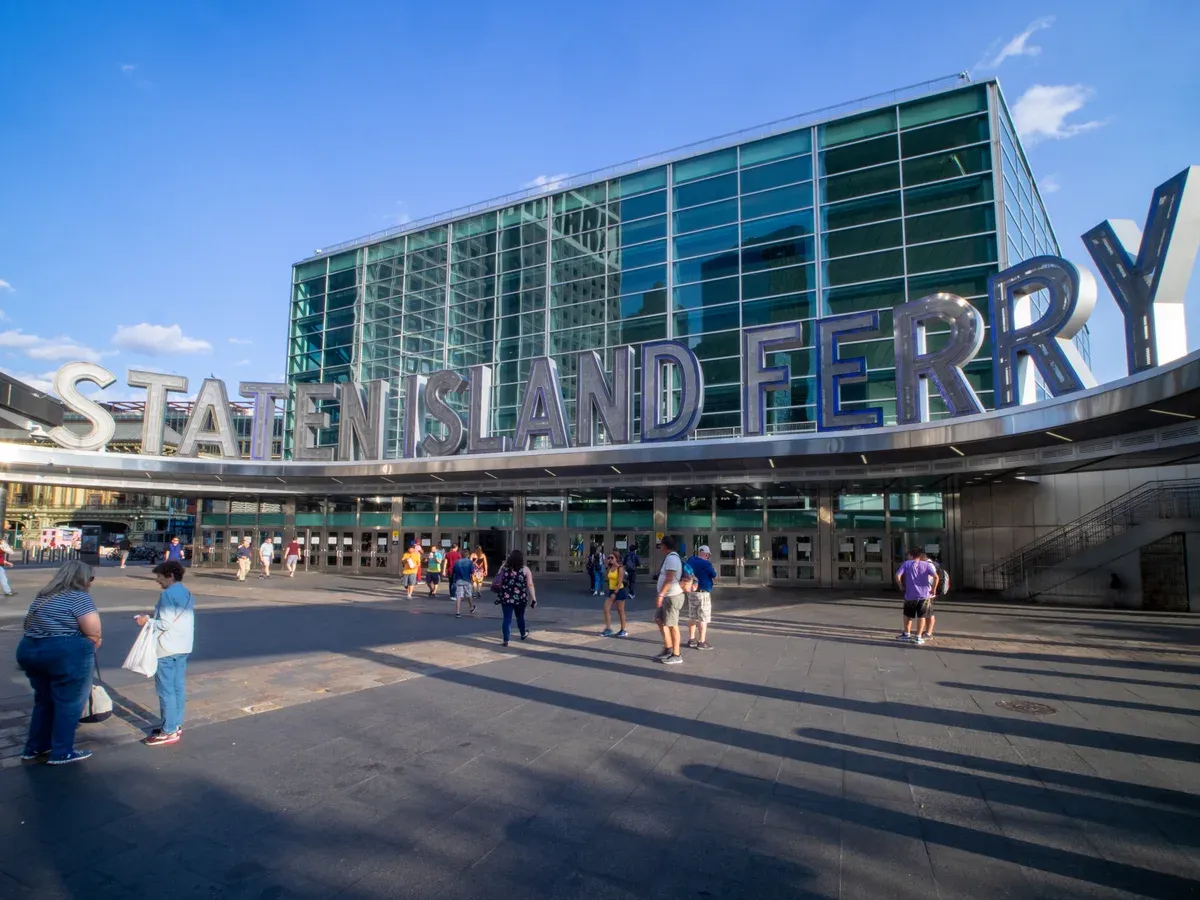
The glass-fronted Whitehall Terminal entrance with the Staten Island Ferry sign in Lower Manhattan. Photo: Ajay Suresh from New York, NY, USA, CC BY 2.0, via Wikimedia Commons
The Boats and the History
The fleet runs nine vessels across four classes, and the route's history stretches back over two centuries. Here is how it unfolded, drawn from the historical record.
A Short Timeline
The table below collects the key dates in the ferry's story, from the first motorized crossing to the modern fleet. Figures come from the historical record of the route and its terminals.
| Year | What happened |
|---|---|
| 1810 | Cornelius Vanderbilt, at age 16, starts his own ferry service with a periauger called Swiftsure. |
| 1817 | The Richmond Turnpike Company begins the first motorized ferry between New York and Staten Island. |
| 1853 | Three ferry companies merge after Vanderbilt sells his operation for $600,000. |
| 1871 | The boiler of the Westfield II explodes at South Ferry, killing between 45 and 91 people. |
| 1905 | New York City takes over the ferry for $3.2 million, including $2 million for five new screw-propelled ships. |
| 1948 | The five-cent fare ends. |
| 1964 | Ridership peaks at 27.5 million passengers, then falls to 22 million the next year after the Verrazzano-Narrows Bridge opens. |
| 1967 | The Staten Island ferry is the only commuter ferry left in New York City. |
| 1991 | A fire destroys the original Whitehall Terminal building. |
| 1997 | The ferry becomes fare-free, and it has stayed free since. |
| 2003 | The Andrew J. Barberi hits a maintenance pier at St. George, killing 11 people and injuring 70. The pilot lost consciousness at the controls, and a city rule requiring two pilots during docking had not been enforced before the crash. |
| 2022 | The first Ollis-class ferries enter service, starting with the SSG Michael H. Ollis. |
The Fleet Today
Nine vessels cover the route across four classes. The newest is the Ollis class, built by Eastern Shipbuilding for $314 million. Each Ollis-class ferry is 320 feet long and 70 feet wide, carries 4,500 passengers with a crew of 16, and is double-ended with a propeller at each end driven by four EMD diesel engines. Three have entered service: SSG Michael H. Ollis, Sandy Ground and Dorothy Day.
The older classes are the Molinari class (Guy V. Molinari, John J. Marchi, Spirit of America), the Barberi class (Andrew J. Barberi, Samuel I. Newhouse) and the Austen class (Alice Austen, John A. Noble). The Barberi is 310 feet long. Capacity figures for the older classes circulated in search results but are not confirmed by the city, so treat any exact number you read elsewhere with caution.
What Sells on Board
The boats run a small concession. NYC Tourism says the ferry sells hot dogs, coffee and beer on board. That is the whole menu story, and no prices for it are stated.
Note that this is not a narrated sightseeing service. For that you would book one of the New York architecture boat tours on the comparison homepage instead.
The Free Ferry or a Paid Cruise
The ferry costs nothing and runs all night. A cruise costs money and buys you things the ferry cannot give. Here is the honest split.
What the Ferry Gives You Free
The fare has been zero since 1997. The boats run 24 hours a day, 7 days a week, every day of the year, leaving every 15 to 20 minutes at peak and every 30 minutes off-peak. You get 25 minutes on the water each way, 5.2 miles across Upper New York Bay, and you can ride back immediately for a 50-minute round trip. From the water you see the harbor, the Lower Manhattan skyline and the harbor islands.
What you do not get is narration, a loop of Manhattan, or any route up the Hudson or East Rivers. The ferry carries no cars, has no guide, and no official source states which side of the vessel is better for the Statue of Liberty, so ignore confident claims on that point.
What a Cruise Adds
A paid cruise buys three things. First, narration: the 90-Minute NYC Statue of Liberty and Skyline Cruise costs $34 per person and carries a live tour guide or audio guide past the Statue of Liberty, Ellis Island and the Chrysler Building. Second, the full loop: the Circle Line Full Manhattan Boat Tour does the full lap of Manhattan in 2.5 hours for $39 per person, and the Manhattan Architecture Yacht Cruise with AIA New York Narration goes further with narration by a member of AIA New York for $85.50 per person over 2 hours 45 minutes. Third, waterways the ferry never touches, including the Harlem River and the Hudson waterfront.
For drinks and atmosphere, the New York Sunset and Skyline Lights Cruise runs 2 hours at $45 per person with cocktails for sale, and the Hudson River Sunset Schooner Sail puts you on an 80-foot schooner for $90.12 with one drink included. A cheaper middle ground is the Starship 90-Minute Landmark Cruise at $26 per person from Pier 78. Compare the current listings on the homepage for New York architecture boat tours before you book.
Tips for Riding the Staten Island Ferry
Do
- Do budget about 25 minutes each way for the crossing, because the 5.2-mile route takes about 25 minutes and the return boat lets you complete a 50-minute round trip at zero cost.
- Do ride at peak times if you can, because boats leave every 15 to 20 minutes at peak against every 30 minutes off-peak, so a missed boat costs you less waiting.
- Do use the South Ferry or Bowling Green subway stations, since the 1, N, R and W trains and the 4 and 5 trains stop within walking distance of 4 South Street.
- Do use the elevators or escalators if you need them, because both terminals follow ADA guidelines and wheelchair users board from the lower level with no documentation.
- Do explore St. George when you land, because the National Lighthouse Museum, the St. George Theatre, the September 11 memorial and the FerryHawks stadium all sit near the terminal.
Don't
- Don't bring a car, because the ferry carries no cars at all, only foot passengers and bikes on the lower level.
- Don't plan to charge devices on board, because charging any e-device on the ferry is prohibited even though e-bikes with pedals may board.
- Don't bring a pet without a carrier, because pets other than service animals must be in a cage or carrier or be muzzled.
- Don't assume the trip includes commentary, because there is no guide or narration on board, and no official source says which side is better for the Statue of Liberty.
Staten Island Ferry Questions
Is the Staten Island Ferry free?
Yes. The ferry has been fare-free since 1997 and runs every day of the week, year-round. That makes it the zero-dollar entry point in any comparison of New York architecture boat tours and harbor rides.
How often does the Staten Island Ferry run?
Boats leave every 15 to 20 minutes at peak and every 30 minutes off-peak, and the service runs 24 hours a day. For the separate paid routes across the East River, see the NYC Ferry guide.
Can you see the Statue of Liberty from the Staten Island Ferry?
The route crosses Upper New York Bay past the harbor islands, so the statue comes into view during the 25-minute crossing. For a dedicated photo stop in front of it, the 90-Minute Statue of Liberty Cruise slows near the statue for photos instead of passing by.
How long is the Staten Island Ferry ride?
The route runs 5.2 miles across Upper New York Bay and takes about 25 minutes each way, so a there-and-back round trip takes about 50 minutes. For longer loops of the island, the Circle Line Full Manhattan Boat Tour takes 2.5 hours.
Does the Staten Island Ferry take bikes and wheelchairs?
Bikes board on the lower level at both terminals and must stay in the designated bike area, and wheelchair users board from the lower level without documentation. Both terminals have escalators and elevators following ADA guidelines.
Where else can I take a cheap ferry from Lower Manhattan?
The seasonal Governors Island boat leaves from the Beaux-Arts Battery Maritime Building at 10 South Street, with $5 adult fares. Details are in the Governors Island ferry guide.